
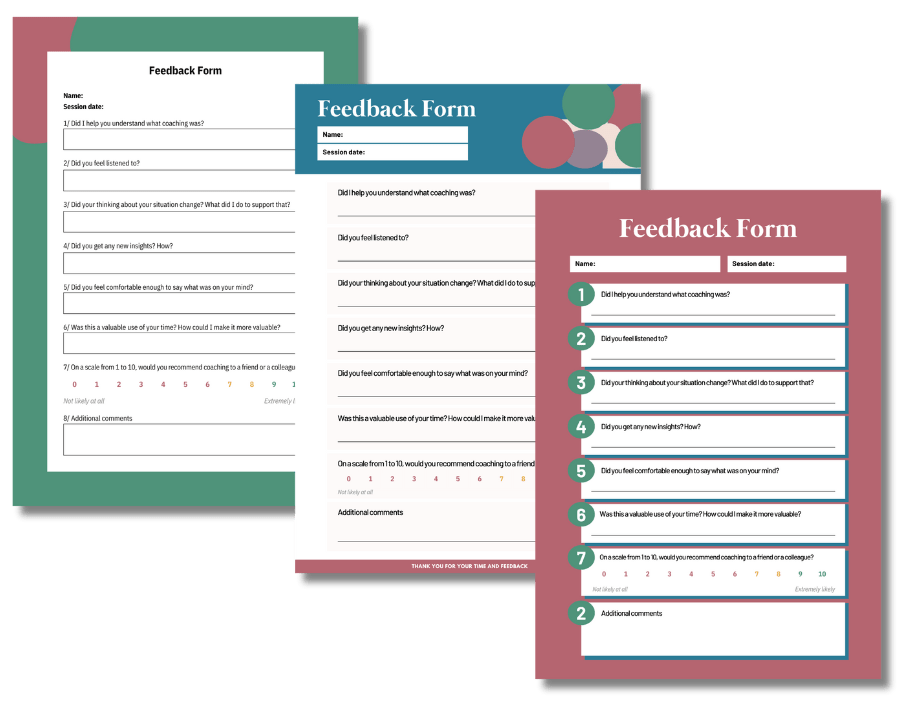
Collecting feedback from your clients is crucial to identify potential blindspots and improve the effectiveness of your practice. Yet many coaches struggle with how to gather meaningful feedback without making the process feel awkward or burdensome.
Whether you’re working towards your ICF credential or you’re an experienced coach looking to enhance your practice, having a structured approach to feedback collection can transform both your coaching effectiveness and client satisfaction.
In this article, we are going to provide you with a complete coaching feedback form template, explore the 12 essential questions every coach should ask, and show you exactly how to implement feedback collection in your practice.
Why Coaching Feedback Forms Are Essential
The ICF’s 2024 Global Coaching Study shows that coaches who regularly collect structured feedback report 40% higher client satisfaction rates and demonstrate faster competency development. This aligns perfectly with several ICF Core Competencies, particularly “Facilitates Client Growth” and “Maintains Presence.”
From our personal experience training coaches and delivering mentor coaching, we see three critical benefits of systematic feedback collection:
1. Accelerates Your Development
Direct client feedback reveals blind spots you might miss in self-reflection. It’s one thing to think a session went well — it’s another to have your client confirm the specific moments that created breakthrough insights.
2. Strengthens the Coaching Relationship
When you actively seek feedback, you demonstrate genuine care for your client’s experience. This vulnerability often deepens trust and creates space for more honest conversations.
3. Provides Evidence for Credentialing
ICF credentialing requires evidence of coaching effectiveness. Client feedback forms provide concrete documentation of your impact and areas for growth.
18 Essential Coaching Feedback Questions
The key to effective feedback collection is asking the right questions at the right time.
Overall satisfaction:
- On a scale of 1 to 10, how satisfied are you with today’s coaching session?
- How likely are you to recommend this coaching service to others? (1-10 scale)
Session impact:
- How effective was the session in helping you achieve your goals? (1-10 scale)
- What specific outcomes or insights did you gain from this session?
About the coach:
- How well did the coach listen to you? (1-10 scale)
- How effectively did the coach ask questions that prompted reflection? (1-10 scale)
- How clearly did the coach communicate? (1-10 scale)
About the session:
- Was the session well-organised and structured? (Yes/No)
- Was the session duration appropriate? (Too short, Just right, Too long)
- How comfortable did you feel during the session? (1-10 scale)
- What aspects of the session could be improved
- Were there any parts of the session that you found unhelpful?
Client progress:
- On a scale of 1 to 10, how much progress do you feel you’ve made toward your goals since starting coaching?
- What obstacles, if any, are still in your way?
- What has been the most significant change you’ve experienced as a result of coaching?
Open-ended questions:
- What should the coach stop, start, and continue?
- What did you find most valuable about this coaching session?
- Any additional comments or feedback?
The beauty of these questions is that they cover all aspects of the coaching relationship whilst remaining simple enough for clients to complete in 5-7 minutes.
Free Coaching Feedback Form Template
We’ve created a ready-to-use feedback form that you can download and customise for your practice. The template includes:
- All the essential questions formatted for easy completion
- Rating scales where appropriate
- Space for open-ended responses
- Professional design reflecting coaching best practices
- Both PDF and Word versions for flexibility
Thank you
Check your inbox to download the template.
How to Implement Feedback Collection in Your Practice
The first thing to establish is your feedback rhythm. We recommend this approach:
1. Session 3 Feedback
After your initial chemistry sessions, collect brief feedback to ensure you’re on the right track.
2. Mid-Programme Evaluation
Halfway through your coaching engagement, use the complete question form. This timing allows for course corrections whilst maintaining momentum.
3. Programme Completion Assessment
At the end of your coaching relationship, gather comprehensive feedback including questions about overall impact and areas for your development.
4. Monthly Check-ins (for longer engagements)
For coaching relationships lasting 6+ months, we suggest brief monthly feedback.
Best Practices for Feedback Collection
Make it part of the agreement: Include feedback collection in your coaching agreement so clients expect and prepare for it.
Choose your timing carefully: Send feedback forms within 24 hours of a session when the experience is still fresh.
Follow up personally: Don’t just collect feedback — discuss it. Use the insights to adjust your approach and show clients you value their input.
Keep it confidential: Clearly communicate how you’ll use the feedback and who (if anyone) will see the responses.
Digital Tools for Feedback Collection
Google Forms
Free, professional, and easy to customise. Responses automatically populate a spreadsheet for tracking trends over time.
Microsoft Forms
Similar to Google Forms but integrates well with Outlook for automated sending.
SurveyMonkey
More advanced features for analysis, though the free version limits responses.
Email Templates
For coaches preferring direct email communication, we’ve included a formatted email version in our template download.
The key here is to choose a method that feels natural for both you and your clients. Some prefer the formality of a survey platform, whilst others respond better to personal emails.
ICF Guidelines for Client Feedback
The ICF Code of Ethics emphasises our responsibility to “honour the trust placed in us by our clients.” This extends to how we collect and use feedback.
Key ethical considerations include:
- Informed consent: Clients should understand why you’re collecting feedback and how it will be used
- Confidentiality: Feedback should remain between you and your client unless they specifically consent to sharing
- Non-coercion: Clients should feel free to decline feedback requests without impacting the coaching relationship
- Professional development: Feedback should genuinely inform your practice, not just satisfy credentialing requirements
Remember, you are a coach seeking to improve your service, not a researcher collecting data.
Your Next Steps
Implementing systematic feedback collection transforms both your coaching effectiveness and client satisfaction. Start by downloading our template and introducing feedback collection to your current clients.
The first thing to do is choose one current client and send them the feedback form after your next session. Their response will give you immediate insights into your coaching impact.
If you’re working towards ICF credentialing, start collecting this feedback now — it becomes invaluable evidence for your credentialing portfolio.
Remember, seeking feedback is itself a coaching skill. You’re modelling curiosity, openness to growth, and commitment to excellence.
LET'S STAY IN TOUCH
If you want to hear from us about all things coaching and not miss any new articles, sign up below 👇
Thank you!
We hope you like the content we will share.